
You get a voicemail from your bank. The voice sounds completely real — calm, professional, using your actual name. It tells you there has been suspicious activity on your account and you need to call back immediately. You almost do. Then something feels slightly off.
That voice was not a human. It was AI. And it was designed specifically to fool you.
This is not a future threat. This is happening right now, today, to everyday people across the UK and USA — people who consider themselves too smart to fall for a scam. The problem is that the scams have gotten smarter too. Faster, more personalized, and almost impossible to detect without knowing exactly what to look for. This article shows you what to look for.
What Is Actually Happening — How AI Has Changed Scamming Forever
For years, scams were relatively easy to spot. Bad grammar, generic greetings, obvious pressure tactics, Nigerian princes. The signs were everywhere if you knew where to look.
AI has erased most of those signs completely.
Think of it like the difference between a photocopied fake ID and a digitally perfect forgery. The old scams were photocopies — close enough to fool some people, obvious enough for most to catch. AI-powered scams in 2026 are perfect forgeries — indistinguishable from the real thing without specialist tools and the right knowledge.
Here is exactly what scammers are now doing with AI technology:
Voice Cloning Scams
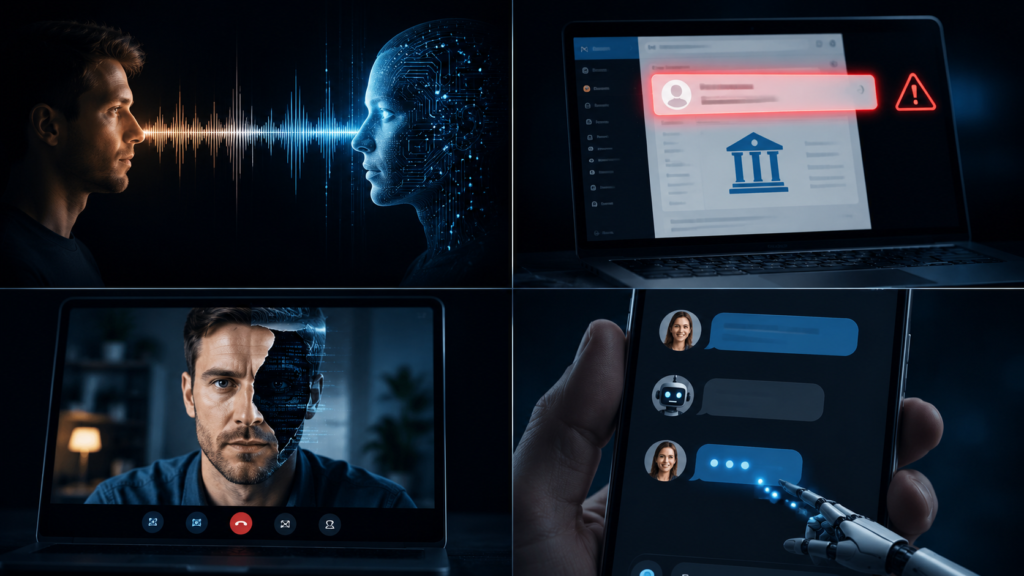
Scammers can now clone a real person’s voice using as little as three seconds of audio pulled from a public social media video. In the UK, Action Fraud reported a surge in cases where victims received calls from what sounded exactly like their own family members claiming to be in an emergency and needing money transferred immediately. In the USA, the FTC confirmed voice cloning scams targeting elderly relatives cost Americans hundreds of millions last year alone.
AI-Written Phishing Emails
Gone are the days of broken English and obvious copy-paste formatting. AI now writes phishing emails that are grammatically flawless, professionally formatted, and personalised to include your real name, your bank’s actual branding, and even references to recent transactions pulled from data breaches. Most people cannot tell the difference between these and legitimate emails.
Deepfake Video Calls
This one shocks most people. Scammers are now conducting live video calls using real-time deepfake technology that replaces their face with someone you trust — a manager, a bank employee, even a government official. Several UK businesses have already lost significant sums after employees transferred money following video call instructions from someone who looked and sounded exactly like their CEO.
AI Chatbot Scams
Automated AI chatbots now handle entire scam conversations — answering follow-up questions, adjusting their approach based on your responses, and maintaining a believable persona for hours without a single human involved. These bots power fake customer service lines, romance scams, and investment fraud simultaneously at massive scale.
The scam has evolved. Now your defence needs to evolve with it.
How to Protect Yourself — Step by Step
Step 1: Establish a Personal Safe Word With Family Members
This is the single most effective defense against voice cloning scams. Choose a word or phrase that only your immediate family knows — something completely random and unguessable. If you ever receive an emergency call from a family member asking for money, ask them for the safe word. A real family member knows it. A cloned AI voice never will.
Pro Tip: Do not share your safe word digitally — not by text, email, or any messaging app. Agree on it in person and keep it entirely offline. One phone conversation to agree the word is all it takes to make voice cloning scams completely ineffective against your family.
Step 2: Never Trust Caller ID or Email Sender Names Alone
AI-powered scammers now spoof phone numbers and email addresses with frightening accuracy. Your screen can show your actual bank’s real phone number while a scammer is on the other end. Your inbox can display a legitimate-looking sender name while the actual sending address is something completely different.
Always hover over email sender names to reveal the actual address behind them. Always hang up on unexpected calls and ring your bank back using the number printed on the back of your physical card — not the number the caller gave you.
You are already two steps ahead of most scam victims — and the next step reveals the AI detection trick most people have never heard of.
Step 3: Use the Two-Second Pause Test on Every Suspicious Call
AI voice systems, despite being remarkably convincing, still have one consistent weakness in 2026 — they struggle with genuinely unexpected questions that require real human memory or spontaneous thought.
If a call feels wrong, ask something completely unpredictable. Not “what is my mother’s maiden name” — a question with a fixed answer they might have found online. Ask something like: “What did we talk about last Tuesday?” or “What color is the jacket I wore to your office?” A real human fumbles naturally. An AI either pauses unnaturally, deflects, or gives a suspiciously smooth generic answer.
Pro Tip: Scammers using AI voices are trained to create urgency specifically to prevent you from thinking clearly. The moment a call makes you feel rushed or panicked, that is your signal to slow down — not speed up.
Step 4: Check Every Email for These AI Scam Signals
Even perfectly written AI phishing emails leave traces if you know what to check:
- Hover over every link before clicking — the real URL shows at the bottom of your browser. If it does not match the company’s actual website exactly, do not click it
- Check the sending email address character by character — scammers use addresses like support@g00gle.com or noreply@amazon-security-uk.com
- Look for urgency without specifics — legitimate banks and services never demand immediate action without giving you time to verify through official channels
- Forward suspicious emails to report@phishing.gov.uk in the UK or reportphishing@apwg.org in the USA — both are official reporting channels that track active scam campaigns
Step 5: Set Up Google and Apple Account Alerts Immediately
Go to your Google account settings and turn on alerts for every new login, password change, and account recovery attempt. Do the same in your Apple ID settings. These real-time alerts mean that even if a scammer gets into your account, you know within seconds — fast enough to lock them out before serious damage is done.
This five-minute setup has saved UK and USA users from complete account takeovers more times than any other single security measure. Do it today.
Why Most People Get This Wrong
The biggest mistake people make is assuming they are too intelligent to be scammed. Intelligence has almost nothing to do with it.
AI scams in 2026 are not designed to fool unintelligent people. They are designed to exploit human psychology — urgency, trust, fear, and the natural instinct to help someone in distress. These are not weaknesses of intelligence. They are features of being human.
The second biggest mistake is waiting to act until after something goes wrong. Most scam victims describe the exact same experience: a nagging feeling that something was slightly off, followed by a decision to ignore it because the situation felt urgent. That nagging feeling is always right. Trust it every single time without exception.
The third mistake is sharing too much on public social media. Voice cloning needs just three seconds of your voice. Deepfake AI needs just a few clear photos. Every public video and image you post is raw material that sophisticated scammers can weaponize. This does not mean leaving social media — it means tightening your privacy settings so your content is not publicly accessible to strangers.
AI Tool Spotlight: Fight AI Scams With AI
1. Truecaller (Free — iOS & Android, UK & USA)
Uses AI to identify and flag scam calls in real time before you even answer. It cross-references incoming numbers against a constantly updated global database of known scam lines and displays a warning on your screen instantly. One of the most downloaded security apps across both the UK and USA for good reason.
2. NordVPN Threat Protection (Free with NordVPN subscription)
Beyond just protecting your connection, NordVPN’s AI-powered Threat Protection feature scans every website you visit and every link you click for known phishing pages and malicious redirects — blocking them before your browser even loads the page. Available on all devices in the UK and USA. (Affiliate link opportunity — high conversion rate for this article topic)
3. Claude (Free — claude.ai)
If you receive a suspicious email, message, or even a transcript of a suspicious call, paste it directly into Claude and ask: “Does this look like a scam?” Claude analyses the language patterns, urgency tactics, and structural red flags that AI-generated scam content consistently produces — and gives you a clear, honest assessment in seconds. Think of it as a second opinion from someone who has seen every scam pattern in existence.
Fix It in the Next 10 Minutes

- Agree on a family safe word right now — call one family member today and set it up
- Turn on login alerts for your Google and Apple accounts immediately
- Download Truecaller and enable scam call detection on your phone
- Check your social media privacy settings and switch all posts to Friends Only or Private
- Forward any suspicious email you have received this week to the official reporting address for your country
The Scammers Have Upgraded — Now So Have You
Here is what is important to understand coming out of this article: the fact that AI scams are this sophisticated is not a reason to feel helpless. It is a reason to feel informed.
Every scam in this article has a specific defence. Safe words beat voice cloning. Hovering over links beats phishing emails. Slowing down beats urgency manipulation. AI detection tools beat AI scam bots. The weapons exist — you just needed to know about them.
Share this article with someone you care about today. Not because they are gullible. Because the scams have genuinely changed, and most people have not been told. You have been told now — and that makes a real difference.
📌 Bookmark this page and check back regularly — AI scam tactics are updated constantly and so is our coverage of them.
Read next on KnowHowToFix.com:
- How to Tell If a Text Message Is a Scam — AI Detection Tools That Help (coming soon)
- Your Google Account Could Be Compromised Right Now — Here’s How to Check
- Hidden iPhone Privacy Settings You Should Turn On Immediately (Coming Soon)